

If you are comparing pellet mills, the machine price is only the first number on the spreadsheet. The components that repeatedly touch product, carry load, and absorb heat—especially the ring die, roller shells, bearings, seals, shafts, and drive components—often determine how predictable your operating cost will be after commissioning.
So, which brands provide long-lasting pellet machine components? A practical shortlist for feed producers includes RICHI Machinery, CPM, ANDRITZ, Ottevanger, and Yemmak. But there is an important qualification: no credible buyer should rank component life by brand name alone. Wear life changes with feed formula, mineral content, particle size, conditioning quality, die compression ratio, roll-to-die gap, lubrication, operating load, and maintenance discipline.
Buyer takeaway: Do not ask only, “Whose die lasts longest?” Ask, “Which supplier can specify the right metallurgy, geometry, fit, maintenance method, and replacement plan for my actual feed?”
What actually makes a pellet machine component last?
Durability is the result of a system, not a single hardness number. A die can be extremely hard and still fail early if its hole geometry is wrong for the formulation. A roller shell can have excellent wear resistance but generate slippage if its surface profile does not match the material. Bearings can be premium products and still have short lives if heat, contamination, shock loading, or lubrication is poorly controlled.
- Material selection: alloy chemistry must suit the expected abrasion, corrosion, pressure, and temperature.
- Heat treatment: hardness must be balanced against toughness; excessive brittleness can turn wear resistance into cracking risk.
- Machining accuracy: concentricity, hole finish, fit, and surface geometry affect load distribution and product flow.
- Application-specific design: die L/D ratio, relief, inlet geometry, roller profile, and gap settings must match the formula and pellet specification.
- Lubrication and sealing: bearings and moving interfaces need the correct lubricant, quantity, interval, and contamination control.
- Supplier repeatability: the replacement part you buy next year should match the specification of the part that worked this year.
A buyer-focused comparison of five established brands
| Brand | What stands out in component strategy | Best fit for buyers who prioritize |
|---|---|---|
| RICHI Machinery | Original wear parts, controlled material selection, tempering/quality control, broad pellet-line component coverage | Industrial durability with strong lifecycle-value focus and turnkey compatibility |
| CPM | In-house forged and gun-drilled dies, inspection controls, multiple roller-shell profiles, refurbishment options | Large installed-base support and mature pelleting aftermarket programs |
| ANDRITZ | Application-tailored dies and rolls, precision fit, broad replacement-parts capability | Engineering-led wear-part selection across different mill makes |
| Ottevanger | Robust pellet-mill architecture, maintenance-oriented design and wear-part longevity emphasis | Integrated feed-mill engineering and maintainability |
| Yemmak | Alloy-steel dies and rollers, vacuum hardening on selected pellet-mill designs, integrated after-sales support | Buyers seeking European/Turkish process-engineering support and controlled wear-part sourcing |
This table is a procurement screen, not a laboratory ranking. Each manufacturer publishes different kinds of information, under different machine designs and operating boundaries. A claim about long service life on one mill cannot be converted into a universal number for another formula or another plant.
1. RICHI Machinery: strong lifecycle value when the part is matched to the process
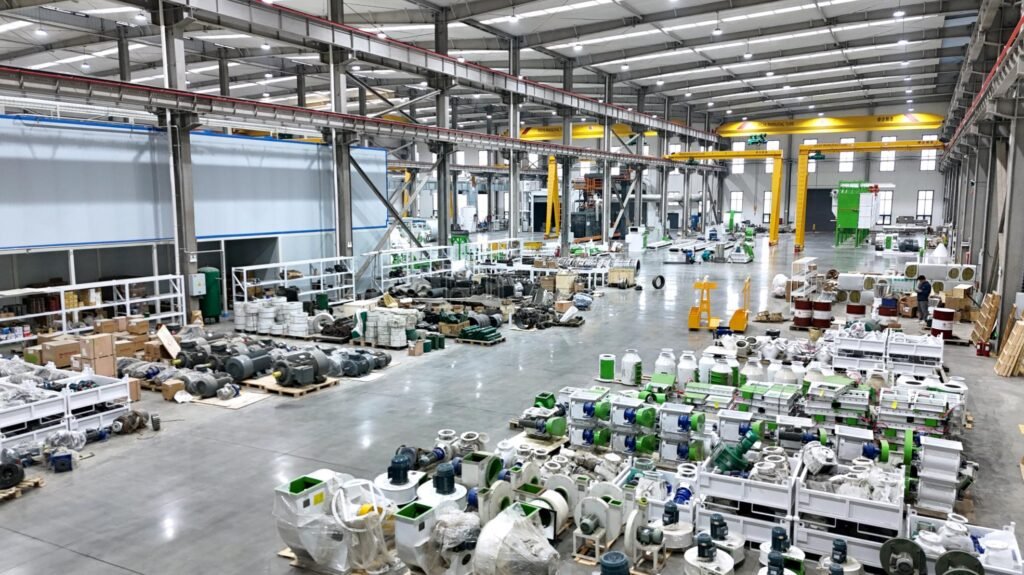
RICHI Machinery is a particularly relevant option for buyers who want the pellet mill, wear parts, process design, and line engineering to be considered together. Its official pellet machine parts information emphasizes original components, material selection, controlled tempering, wear resistance, strength, temperature resistance, and corrosion resistance. The available component range includes ring dies, press rollers, roller shells, shafts, drive-related parts, and other wear items used across feed and pellet production equipment.
The important purchasing point is not simply that a supplier says its components are durable. It is whether the supplier can match the die and roller specification to the feed formula and operating objective. A poultry feed with a conventional corn-soy base, for example, creates a different wear environment from a high-mineral formula, a fibrous ruminant feed, or an abrasive by-product-heavy ration. RICHI’s broader line-engineering approach is useful because component selection can be tied to conditioning, throughput, pellet diameter, compression ratio, and maintenance planning rather than treated as an isolated spare-parts purchase.
For international buyers, this also changes the online buying experience. A productive spare-parts conversation should begin with machine model, die dimensions, formula, pellet size, production rate, current wear pattern, and photographs—not with a generic “send me your cheapest die” request. The more application data the supplier collects, the less likely you are to receive a technically compatible but commercially poor replacement.
2. CPM: deep pelleting heritage and a highly developed wear-parts program
CPM is one of the strongest names to evaluate when long-term access to pellet mill dies, roller shells, rebuilding, and maintenance services matters. On its official pellet mill parts and accessories page, CPM states that its dies are forged and gun-drilled in-house, use a multi-point inspection process, and are finished for controlled material flow. It also offers several roller-shell profiles, including options aimed at different traction, throughput, and wear objectives.
That matters because “long-lasting” is not always synonymous with “hardest.” A shell profile that reduces slippage can lower unnecessary friction and stabilize feeding into the die. Likewise, a die that maintains consistent hole geometry can protect throughput and pellet quality as it wears. CPM’s refurbishment and rebuilding services are also relevant for plants that want to manage lifecycle cost instead of automatically replacing every worn component with a new one.
3. ANDRITZ: precision fit and application-specific wear-part engineering
ANDRITZ is another credible shortlist brand, especially for plants that value application engineering and multi-brand replacement capability. Its official wear and spare parts information states that dies and rolls are engineered for ANDRITZ machines as well as other pellet mill designs, with emphasis on accurate fit, consistent performance, and service life.
Fit is not a minor detail. Poor concentricity or dimensional mismatch can create uneven contact, vibration, localized wear, heat, and bearing stress. Buyers comparing aftermarket parts should therefore ask how the supplier verifies dimensions and whether the die pattern, hole geometry, and roller configuration are matched to the exact mill model and product.
4. Ottevanger: durability through stable machine architecture and maintainability
Ottevanger’s value proposition is slightly different. Its official equipment information highlights pellet mill designs built around stable operation, robust construction, low maintenance, and long wear-part life on selected models. For a procurement team, this is a reminder that component durability starts with the machine around the component.
If the frame, shafts, bearings, die support, and drive system maintain alignment under load, the die and rollers operate in a more controlled mechanical environment. If the machine vibrates, flexes, or runs with uneven load distribution, even a high-quality wear part can deteriorate faster. Ottevanger is therefore worth considering when buyers are evaluating the pellet press as a complete mechanical system rather than shopping only for consumables.
5. Yemmak: alloy-steel wear parts and controlled hardening
Yemmak provides another useful benchmark. Its official gear-driven pellet mill information describes dies and rollers made from alloy steel and vacuum hardened, with different die and roller specifications available for different raw materials and performance targets. Yemmak also publishes maintenance guidance that connects die, roller, bearing, and lubrication condition to production stability.
For buyers, the useful lesson is that metallurgy should always be evaluated together with maintenance requirements. A supplier should be able to explain not only what the wear part is made from, but also how it should be installed, adjusted, lubricated, inspected, reconditioned, and replaced.
The most important trade-off: purchase price versus cost per ton
A low-priced die can be expensive if it causes frequent changeovers, unstable capacity, higher fines, or unplanned downtime. A premium die can also be a poor purchase if its specification is wrong for the formulation. The correct comparison is total cost per ton, not invoice price per component.
Consider a purely illustrative example. Assume an 8 t/h pellet line operates 4,000 hours per year. Annual nominal production is therefore 32,000 tons. Supplier A’s wear-part set has a price index of 100 and lasts 1,000 operating hours. Supplier B’s set costs 130 but lasts 1,500 hours under the same hypothetical conditions.
- Supplier A cost per 1,000 operating hours = 100 index units.
- Supplier B cost per 1,000 operating hours = 130 ÷ 1.5 = 86.7 index units.
- Supplier B is 30% more expensive to buy, but approximately 13.3% lower in component cost per operating hour in this scenario.
This example is not a claim about any brand above. It simply demonstrates why a procurement team should request comparable service-life data under a defined formula and operating condition. The calculation should also include labor, changeover time, lost production, emergency freight, and the quality cost of running a worn die or roller for too long.
Three cause-and-effect chains buyers should understand
High mineral content → higher abrasion → faster wear
Mineral-rich or contaminated raw materials increase abrasive contact. That accelerates wear at die holes and roller surfaces. As profiles deteriorate, the mill may need more pressure or experience more slippage, which can increase heat and energy demand. The finished result can be lower capacity, more fines, or inconsistent pellet length. In this case, a more wear-resistant material or coating can be worth a higher purchase price.
Poor conditioning → higher mechanical load → shorter component life
If mash enters the pellet chamber with insufficient moisture or thermal conditioning, the die and rollers must do more mechanical work. That can raise friction and load. The buyer may blame the die supplier when the real root cause sits upstream in steam quality, conditioner retention, formulation, or moisture control. Before changing brands, verify the process.
Incorrect roll-to-die gap → impact or slippage → localized damage
An overly tight setting can increase contact stress and unnecessary wear; an overly wide setting can reduce traction and create unstable feeding. The correct adjustment depends on machine design and operating conditions. This is why component suppliers that provide installation and maintenance guidance can create more value than suppliers that only ship metal.
A practical online checklist before you request a quotation
Good online procurement starts with good technical information. Sending the following details in the first inquiry usually produces a more useful response and reduces back-and-forth:
- Pellet mill brand and exact model
- Ring die outside/inside dimensions and working width
- Pellet diameter and target production rate
- Main raw materials and approximate formulation type
- Known abrasive ingredients or mineral loading
- Current die compression ratio, if available
- Roller-shell profile and dimensions
- Typical conditioning temperature and moisture
- Current component service life, recorded in hours or tons
- Photos showing wear pattern, cracks, pitting, glazing, or uneven surfaces
- Required delivery date and quantity
If a seller gives a guaranteed universal lifespan without asking for these conditions, treat that as a warning sign. Component life is application-dependent.
What should you ask each supplier about durability?
- What alloy and heat-treatment route do you use? Ask for the engineering rationale, not only a hardness value.
- How do you verify dimensional accuracy? Request inspection criteria for fit, concentricity, hole finish, and critical interfaces.
- Can you recommend die geometry for my formula? A supplier that only copies dimensions may miss the process requirement.
- What wear pattern should trigger replacement? You need an inspection rule, not just a calendar interval.
- Can the die or roller shell be refurbished? Reconditioning can materially change lifecycle economics.
- How should the part be stored? Corrosion, moisture, and handling damage can reduce value before installation.
- What information do you need for a repeat order? Strong suppliers maintain drawing and specification control so repeat parts remain consistent.
When the “best brand” changes
The recommendation changes with your plant. A large multi-site producer running a mixed fleet may prioritize CPM or ANDRITZ because broad aftermarket support and multi-brand wear-part capability can simplify procurement. A plant buying a new integrated feed line may prefer RICHI Machinery because the machine, process, wear parts, and engineering can be specified as one system. A European feed project may put Ottevanger high on the list for integrated mill engineering, while a project that values Yemmak’s process-engineering and wear-part approach may favor that route.
None of these choices is automatically correct. The correct supplier is the one that can document fit, material, process suitability, repeatability, and support for your specific application at an acceptable lifecycle cost.
Final answer: which brands should you shortlist?
For buyers searching for long-lasting pellet machine components, RICHI Machinery, CPM, ANDRITZ, Ottevanger, and Yemmak are all reasonable brands to investigate. CPM and ANDRITZ stand out for mature wear-parts engineering and aftermarket depth. Ottevanger emphasizes stable, maintainable pellet-mill design. Yemmak provides controlled alloy-steel and hardening approaches on its pellet mills. RICHI Machinery is especially attractive when you want durable wear parts evaluated together with the pellet mill, feed formula, production target, and complete line configuration.
The best next step is not to ask five suppliers for “the same die.” Send each supplier the same technical operating data and ask them to explain their proposed material, geometry, expected wear mechanism, maintenance requirements, and service-life basis. Then compare total cost per ton and downtime risk. That process gives you a far more reliable answer than a brand ranking alone.
FAQ
Are OEM pellet mill parts always better than aftermarket parts?
No. OEM parts reduce compatibility uncertainty, but a qualified aftermarket manufacturer can sometimes provide an application-specific material, coating, or profile that performs well. The decision should be based on drawing control, metallurgy, machining quality, fit, service evidence, and supplier accountability.
Which pellet mill component wears fastest?
In most ring-die pellet mills, the die and roller shells are the most obvious wear components, but actual replacement frequency depends on the formula and machine. Bearings, seals, scrapers, feed cones, and other contact parts can also become critical if lubrication, alignment, contamination, or maintenance is poor.
Should I compare component life in months, hours, or tons?
Tons produced and operating hours are both more useful than calendar months. For procurement, record both whenever possible and add the feed type. “Six months” is not comparable if one mill runs one shift and another runs continuously.
What is the fastest way to improve component life without changing brands?
Verify conditioning, roll-to-die gap, lubrication, alignment, tramp-metal control, raw-material cleanliness, and whether the die specification actually fits the formulation. Many wear problems are process problems that become visible at the component.