
New pet food plants often focus on the machine. Investors compare extrusion capacity, motor power, die configurations, and price. These factors matter, but they are not what determines whether a plant runs well six months after commissioning. What determines success is the people operating the line and the systems supporting them.
A plant with mid-range equipment and a well-trained team will outperform a plant with premium equipment and operators who do not understand the process. This pattern appears in feed mills, food processing plants, and pet food factories around the world. The equipment sets the ceiling. The people determine whether the plant reaches it.
The Gap Between Installation and Production
Commissioning is a milestone, not a destination. When the supplier’s engineers leave, the plant must run on its own. That transition is where many projects struggle.
During commissioning, the supplier’s team adjusts settings, troubleshoots problems, and makes decisions based on experience. They know how the machine behaves when the formula is too wet, when the die is worn, or when the motor load is climbing. They can hear when something is wrong.
After commissioning, that knowledge leaves with them unless it has been transferred. If the plant’s operators only learned which buttons to press, they will struggle the first time conditions change. Raw materials shift. Formulas change. Equipment wears. Without a deeper understanding of the process, operators cannot respond.
This is why training should not be treated as a final step. It should be built into the project from the beginning. Operators should understand not just what to do, but why.
What Operators Actually Need to Know
Pet food extrusion is a continuous process with many interacting variables. An operator does not need to be an engineer, but they do need to understand the relationships between the key parameters.
Moisture. Water affects cooking, expansion, and texture. Too little moisture and the product may not cook properly. Too much and the kibble may not hold its shape.
Temperature. Heat drives starch gelatinization and protein denaturation. Different formulas require different temperature profiles.
Screw speed. This affects shear, mixing, and retention time. Changing screw speed changes the product.
Die selection. Die diameter, open area, and thickness affect kibble size, density, and output.
Dryer settings. Temperature, airflow, and retention time determine final moisture and product quality.
Coater settings. Fat level, vacuum pressure, and coating time affect palatability and appearance.
An operator who understands these relationships can make adjustments when conditions change. An operator who only follows a fixed procedure will produce inconsistent product when the inputs vary.
Documentation and Manuals
Equipment suppliers typically provide technical documentation, including an operation manual and a maintenance guide. These documents are useful, but they are not a substitute for training. A manual explains what the machine does and how to service it. It does not explain how to make a specific product with a specific formula under specific conditions.
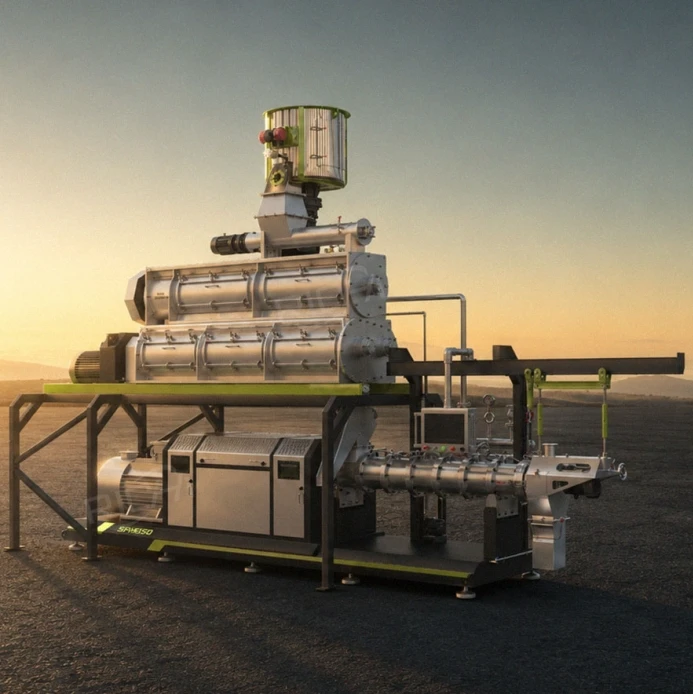
Producers looking for a pet food extrusion machine operation manual pdf and maintenance guide download often want a reference they can use during daily operation. That is a reasonable need, but the manual should be treated as a starting point. The real knowledge comes from running the line, recording results, and learning from experience.
A practical approach is to build a plant-specific manual over time. Start with the supplier’s documentation. Add notes on what works with local raw materials. Record the settings that produce good results for each product. Document the problems that have occurred and how they were solved. Over time, this becomes more valuable than any generic manual.
Maintenance as a Production Function
Maintenance is often treated as a cost center. In reality, it is a production function. A plant that maintains its equipment well produces more, wastes less, and has fewer quality problems.
Extruders have wear parts. Screws and barrels wear over time, reducing cooking efficiency and changing product characteristics. Dies wear and need replacement. Bearings fail. Seals leak. Dryers and coaters have their own wear items.
A maintenance schedule should cover daily, weekly, monthly, and annual tasks. Daily checks include lubrication, temperature readings, and visual inspection. Weekly tasks include cleaning and minor adjustments. Monthly tasks include more detailed inspection. Annual tasks include overhaul and replacement of worn parts.
Spare parts inventory is part of maintenance planning. If a critical part is not available, the plant may wait days or weeks for delivery. In some regions, importing a die or screw can take a long time. Keeping essential spares on hand is expensive, but less expensive than losing production.
Quality Control and Record-Keeping
Quality control in pet food production is not just a final inspection. It is a series of checks throughout the process. Incoming materials are tested. In-process parameters are monitored. Finished product is sampled and evaluated.
Record-keeping supports quality control. Production logs, test results, and maintenance records should be kept and reviewed. Trends can reveal problems before they become serious. A gradual increase in motor load may indicate die wear. A change in product color may indicate a change in raw materials. A rise in fines may indicate a drying problem.
Records also support traceability. If a customer complains about a batch, the producer can identify what went into it, when it was made, and under what conditions. This helps resolve the problem and prevent recurrence.
Workforce Planning
Pet food plants need several types of workers. Operators run the extrusion line. Maintenance technicians service equipment. Quality control staff test materials and products. Warehouse workers handle raw materials and finished goods. Supervisors coordinate production and respond to problems.
Finding skilled workers can be difficult, especially in regions where the pet food industry is young. Training programs, whether internal or external, help build the needed skills. Some producers partner with technical schools or equipment suppliers to develop training.
Retention matters as much as recruitment. Experienced operators are valuable. A plant that loses its best operators will struggle to maintain quality. Competitive pay, clear career paths, and a safe working environment help retain staff.
What Suppliers Should Provide
Equipment suppliers can do more than deliver machines. They can provide training, documentation, spare parts, and ongoing technical support. A supplier who offers these services is more valuable than one who only sells equipment.
Training should cover operation, maintenance, and troubleshooting. It should be hands-on and specific to the plant’s formulas and products. It should include both classroom sessions and practical work on the line.
Documentation should include operation manuals, maintenance guides, spare parts lists, and electrical diagrams. It should be in a language the plant’s staff can read. It should be organized so that information can be found quickly.
Spare parts support should include a recommended spare parts list, lead times, and pricing. Some suppliers offer kits for common maintenance tasks. Others provide remote support for troubleshooting.
Ongoing technical support is important as formulas change and equipment ages. A supplier who can answer questions and provide guidance over the life of the plant is more valuable than one who disappears after commissioning.
Planning for the Long Term
A pet food plant is a long-term investment. The equipment may last ten years or more. The formulas will change. The market will change. The team will change. Planning for these changes is part of building a sustainable business.
Product development should continue after launch. New products, new formulas, and new packaging keep the business competitive. This requires the ability to test and trial new ideas without disrupting production.
Equipment upgrades should be planned as the business grows. A line that starts at a modest capacity may need to expand later. Layout, utilities, and material handling should allow for this.
Training should be ongoing, not a one-time event. New workers need to learn the basics. Experienced workers need to update their knowledge as formulas and equipment change.
Common Mistakes in Plant Operation
Several mistakes appear repeatedly in pet food plants after commissioning.
Relying on a single experienced operator. If that person leaves, the plant loses critical knowledge. Cross-training reduces this risk.
Neglecting maintenance. Short-term savings lead to long-term downtime and quality problems.
Skipping records. Without records, problems cannot be traced and improvements cannot be measured.
Ignoring small changes. A gradual increase in fines or a slight change in product color may indicate a developing problem.
Underinvesting in training. Operators who do not understand the process cannot respond effectively when conditions change.
Conclusion
Pet food production is a technical business, but it is also a human business. The equipment provides the capability. The people determine whether that capability is used well. A pet food extrusion machine is only as good as the team operating it.
Producers looking for a pet food extrusion machine operation manual pdf and maintenance guide download should recognize that documentation is a starting point, not a solution. The real knowledge comes from training, experience, and systematic record-keeping. Manufacturers such as Richi Manufacture can provide documentation and support, but the plant must build its own capability over time.
For producers who invest in their people and their systems, pet food production can be a stable and profitable business. For those who focus only on the machine, the plant may never reach its potential. The difference lies in the preparation, not the equipment.