
A feed pellet mill and an organic fertilizer granulator both press damp powder through a die and extrude it as a shaped pellet, and that surface resemblance leads many plant owners to treat the two duties as one technology with two products. They are not. Three variables separate them, and those variables decide almost every equipment choice: how the feedstock behaves when it is wet, how much heat and pressure the material tolerates, and what actually binds the pellet together. Settling these questions before a project is priced prevents the most expensive mistake in this field, which is buying a machine that is technically a pelletizer but functionally wrong for the material.
This article compares feed pelleting and organic fertilizer granulation on the same site. It sets out where the two routes genuinely share hardware, where they must not be confused, which feedstock questions have to be answered first, and how those answers change the granulation section, the drying duty and the operating routine. It is written for plants that already run animal feed or biomass pellets and are weighing a second product line, as well as for buyers who are simply trying to keep the two purchase decisions apart.
Two Products That Only Look Alike at the Die
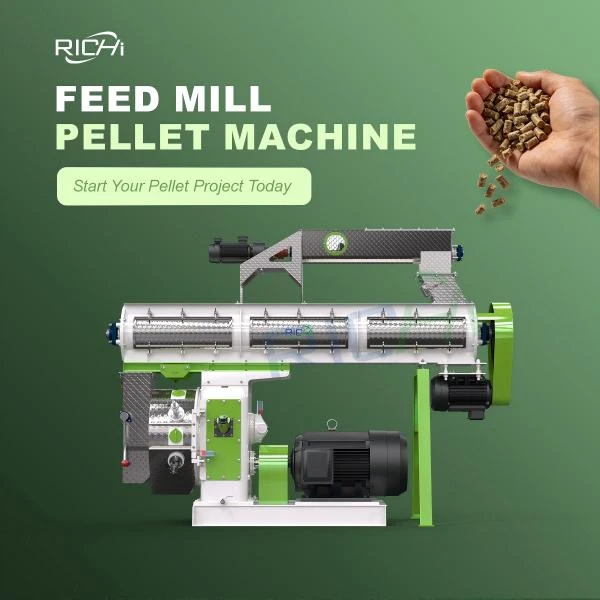
Both processes rely on compression: prepared material is forced through die holes or rolled into a growing granule, and the result has to survive handling without collapsing. That is where the shared physics ends. Feed pelleting is built around conditioning. Ground grain, protein meals and premix are heated with steam to roughly 70 to 90 degrees Celsius, moisture is raised into a narrow window, starch gelatinises, and the resulting plasticity is what holds the pellet together as it leaves the die. The pellet then has to be cooled, crumbled or screened to size, and it must stay hard enough to be transported and eaten without falling apart.
Organic fertilizer granulation starts from a different premise. The material is often fibrous, sandy, uneven and already wet, and its binding comes from moisture plus the adhesive nature of the organic matter itself, sometimes reinforced with a binder such as molasses, starch, clay or humic acid. Heat is usually the enemy rather than the tool, because organic fertilizers are frequently blended with microbial or enzymatic additives that a steam conditioner would destroy. The two routes therefore meet at the die but arrive from opposite directions.
| Process dimension | Feed pelletizing | Organic fertilizer granulation |
|---|---|---|
| Feedstock moisture at the die | Raised by steam conditioning into a narrow band | Carried in wet, often 25 to 35 percent before drying |
| Heat input | Steam conditioning, typically 70 to 90 degrees Celsius | Normally none; the process runs at or near ambient temperature |
| Binding mechanism | Gelatinised starch plus moisture and pressure | Moisture and the material’s own adhesion, frequently with a binder |
| Typical granule size | Commonly 2 to 6 millimetres | Wider range, from 2 millimetres up to coarse 10 millimetre blends |
| Wear drivers | Mineral premix and hard grains | Sand, soil and grit carried in with the raw material |
| Durability requirement | High, because of transport, handling and animal intake | Moderate, since some crumbling is acceptable in field use |
| Dominant downstream step | Cooling, crumbling and screening | Drying first, then cooling, screening and often coating |
Read down the last column and the practical consequence appears: on a fertilizer line the dryer is not an accessory, it is the unit that sets the plant’s real capacity, while on a feed line the cooler and the crumbler do that job.
Where the Feed Line Sets the Limit
A feed pellet mill is dimensioned around throughput at a defined formulation. Die compression ratio, conditioner volume, roll pattern and motor power are all chosen from an expected range of density, grind size and abrasiveness, and that works because animal feed recipes stay inside a fairly predictable band. Moisture is controlled before the conditioner, particle size is controlled after the hammer mill, and the machine can be promised a rated output with reasonable confidence.
Fertilizer feedstock refuses that discipline. Compost, poultry litter, cattle manure, crop residues and straw char can differ in moisture, bulk density and fibre length from one delivery to the next, and sometimes from one heap to the next. A machine fed that material will not hold a nameplate capacity, wear parts will consume faster, and a larger share of the output will fall outside the target size and have to be recycled. None of this means the equipment is weak; it means the assumption behind the capacity figure no longer applies.
What Carries Over Between the Two Lines
Some of a feed plant is genuinely reusable. Conveying and dosing systems, hammer mills, crumbler rolls, vibrating screens, dust collection, bucket elevators, storage silos, weighing and bagging equipment all serve both products, and existing skids, hardstanding and buildings can usually be shared without modification. That overlap is real, and it is the reason a second product can be added to an established site at a far lower cost than a greenfield build.
The granulation section itself is where the argument for purpose-built equipment becomes decisive. Where a site already runs feed pelleting and wants to add fertiliser granulation, the practical route is usually a separate, purpose-built organic fertilizer production line rather than a converted feed pellet mill, because the granulation unit, the dryer and the coater each carry a different duty from their feed-side counterparts, and keeping them separate protects the quality claims of both products.
What does not travel across is the tooling and the thermal design. Die and roll assemblies are matched to compression ratio, hole geometry and alloy for a specific material, and a die that flattens under fibrous damp material or wears out on gritty compost is not the die that makes durable feed pellets. Conditioners have no role on a heat-sensitive fertilizer recipe. Conversely, a fertilizer granulator has no steam system, but it does need a dryer and a much more forgiving screening arrangement, so the two lines converge only at the level of the building they sit in.
Feedstock Questions That Come Before Any Machine
The order of engineering on a fertilizer project is the reverse of the order most buyers expect. The first step is not to choose a granulation style, it is to characterise the material. Moisture content and its variation across deliveries, bulk density, fibre length after shredding, sand and grit content, and the presence of additives that cannot be heated will each eliminate part of the equipment catalogue before a single price is discussed. A pilot granulation trial on a representative sample is far cheaper than discovering after installation that the material will not form a stable granule in the moisture window the line was designed around.
Formulation follows the material. Binders are chosen for what the feedstock lacks, not for what is convenient to dose, and the amount added has to be balanced against the drying load, because every extra litre of water in the mix becomes fuel or electricity in the dryer. The same logic applies on the feed side, where the recipe is fixed by nutrition and the machine is sized around it. On the fertilizer side the recipe is a process decision, and it can be adjusted to make the line work.
| Question to settle before ordering | Why it changes the equipment |
|---|---|
| How wet is the incoming material, and how much does it vary? | Decides whether the dryer is a supporting unit or the bottleneck of the whole line |
| What are the bulk density and fibre length after shredding? | Sets die compression ratio, roll or disc pattern, and the design of the feeding section |
| How abrasive is the material, and how much grit comes with it? | Sets wear-part alloy, spares strategy and the realistic maintenance interval |
| Are heat-sensitive additives present? | Rules out steam conditioning and hot-air drying routes for the product itself |
| What granule size and durability does the market actually demand? | Chooses between disc, pan, drum and extrusion granulation, and sets the screening cut |
| What utilities exist on site: steam, gas, power, space? | Determines whether drying is economic, and whether a second line fits the available footprint |
Answering these six questions changes the specification more than any comparison of motor sizes, and they are the same questions a competent supplier will ask before quoting a line.
Commissioning and Operating Differences
On a feed line, commissioning is finished when pellet durability, throughput and fines are stable and the operators can start and stop the section without supervision. On a fertilizer line the difficult part is the moisture balance through the dryer and the proportion of on-size granules leaving the screen. Mill throughput matters less than the yield of sellable granules, because every oversized granule and every undersized particle is recycled, and the recycle rate quietly consumes the capacity that was purchased.
The operating routine differs too. Feed pellets are judged by hardness and appearance, so operators react quickly to any change in conditioning. Fertilizer granules tolerate more crumbling, which makes the process feel more forgiving, but the same tolerance hides developing problems: a slow rise in wet recycle, an increasing load on the dryer, or grit building up in the granulation section will show up in cost long before the product looks wrong. Where both products share one site, cleaning and changeover protocol between campaigns deserves to be written down at the design stage, not improvised later.
Frequently Asked Questions
Can a feed pellet mill be used to make organic fertilizer granules?
It can physically extrude many fertilizer mixes, but it is rarely a good commercial choice. Feed dies and conditioners are matched to a dry, steam-conditioned recipe, while fertilizer material is wet, fibrous and often gritty, which drops output, accelerates wear and makes moisture control harder. Reusing the die assembly usually costs more in spares and lost output than a granulation section sized for the material.
Why does an organic fertilizer line almost always need a dryer?
Because granulation works best in a wet window. Material enters the granulator with enough moisture to bind, and the granule that leaves it is too wet to store, screen or bag. The dryer therefore sets the real capacity of the plant, and the choice between hot-air, drum or other drying routes is driven by whether the product contains additives that cannot be heated.
Is organic fertilizer granulation always done at ambient temperature?
No, but ambient or low-temperature operation is the common case, especially for bio-organic and microbial products where heat would reduce the active content. Some mineral and blend lines are dried more aggressively, and some processes deliberately add a small amount of heat to help binding. The decision belongs to the formulation, not to the equipment catalogue.
Do fertilizer granules need the same durability as feed pellets?
Generally not. Feed pellets travel through handling, storage and feeding systems and must resist crumbling so animals receive a consistent ration. Fertilizer granules are judged more by size uniformity and by how they spread, and some crumbling is acceptable in the field. That lower standard is useful, but it also means quality problems on a fertilizer line show up in the cost of recycled material rather than in the appearance of the product.
Can feed and fertilizer production share one building?
Usually yes, provided the two processes are treated as separate lines. They share conveying, storage, screening, dust collection and bagging, which is where the savings come from, but they should not share the granulation tooling, the conditioner or the drying strategy. Cross-contamination control and a defined changeover routine are the two points that decide whether sharing a building stays an advantage.
What test should come first on a fertilizer project?
A trial on a representative feedstock sample, before any line layout is fixed. Moisture range, density, fibre length and grit content will decide more of the specification than any equipment comparison, and a successful pilot granulation gives the supplier a defensible basis for a capacity guarantee instead of an estimate.
Feed pelleting and organic fertilizer granulation can live on the same site, and they often should, because they share a large part of the materials handling and storage infrastructure. What they cannot share is the assumption that one machine, one die and one thermal design will serve both products. The projects that go smoothly are the ones that characterised the feedstock first, chose the granulation and drying route from that data, and kept the two processes separate where separation actually protects product quality. Everything else, from conveyors to bagging lines, can be planned around them.