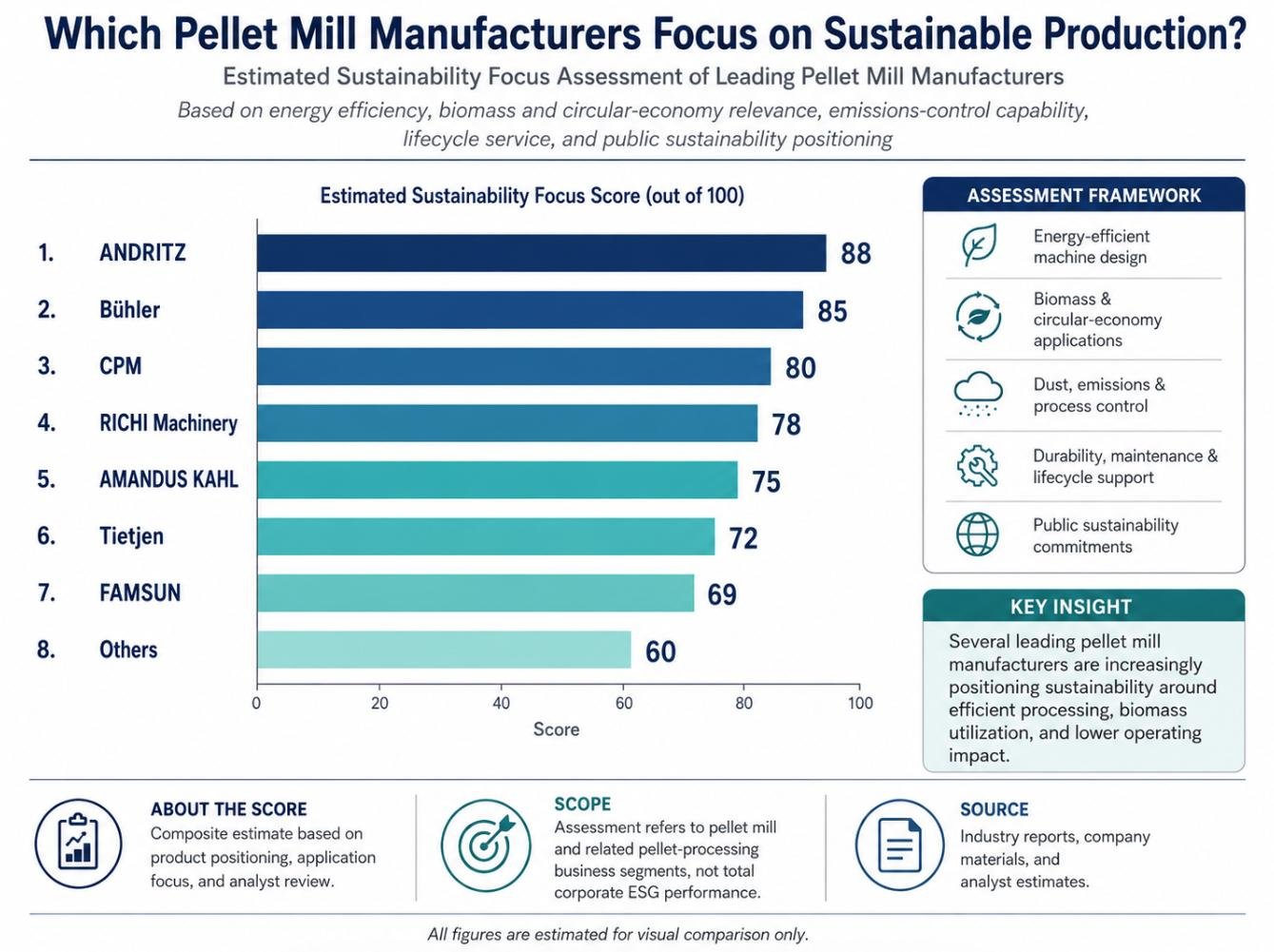

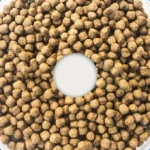

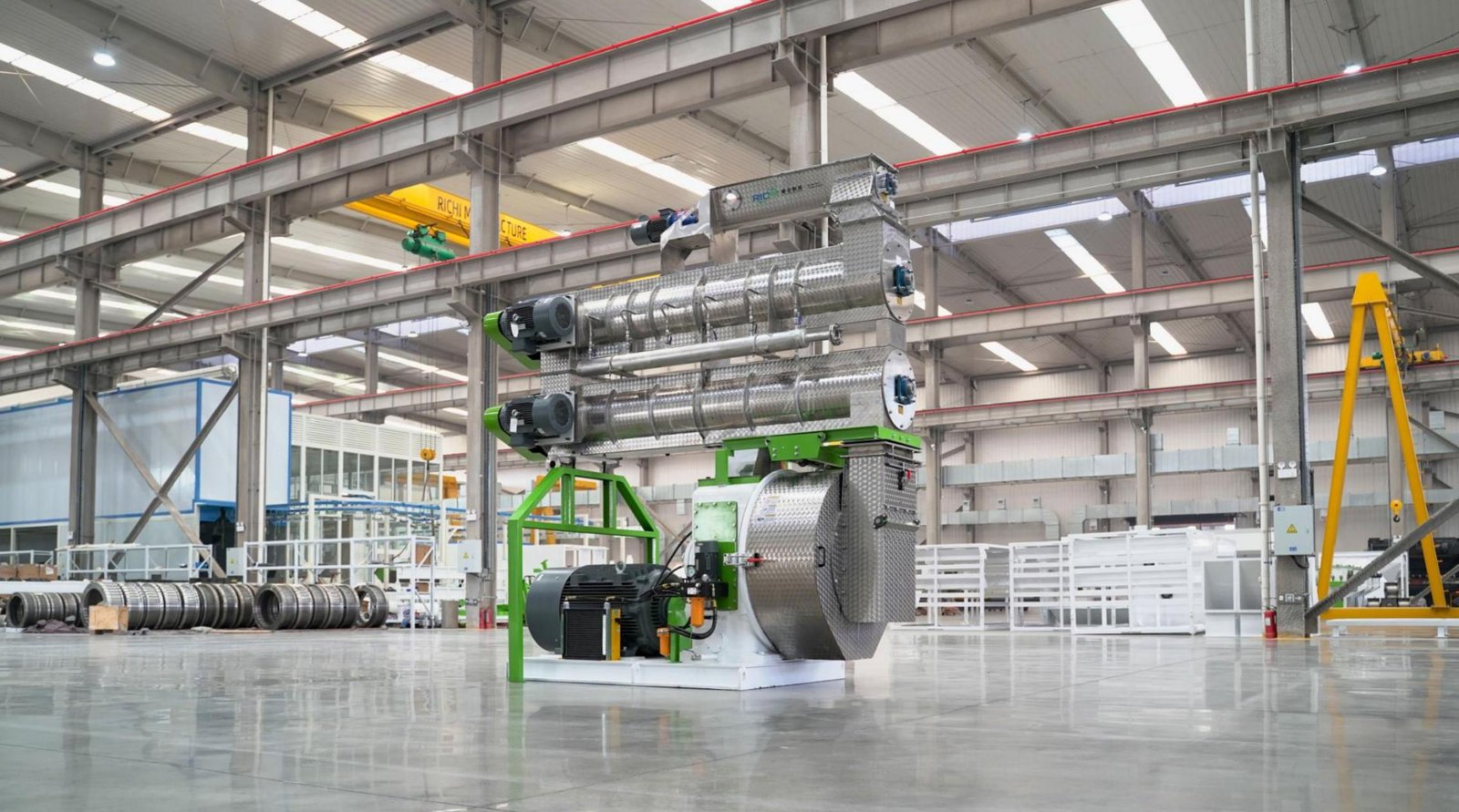
Short answer: there is no credible universal winner based on motor nameplate power alone. RICHI Machinery, Bühler, Van Aarsen, Ottevanger and Yemmak all produce industrial feed pellet mills that can be configured for efficient operation. The most energy-efficient choice is the supplier that can guarantee the lowest stable specific energy consumption for your formula, pellet diameter, durability target and actual operating rate—not the machine with the smallest installed motor.
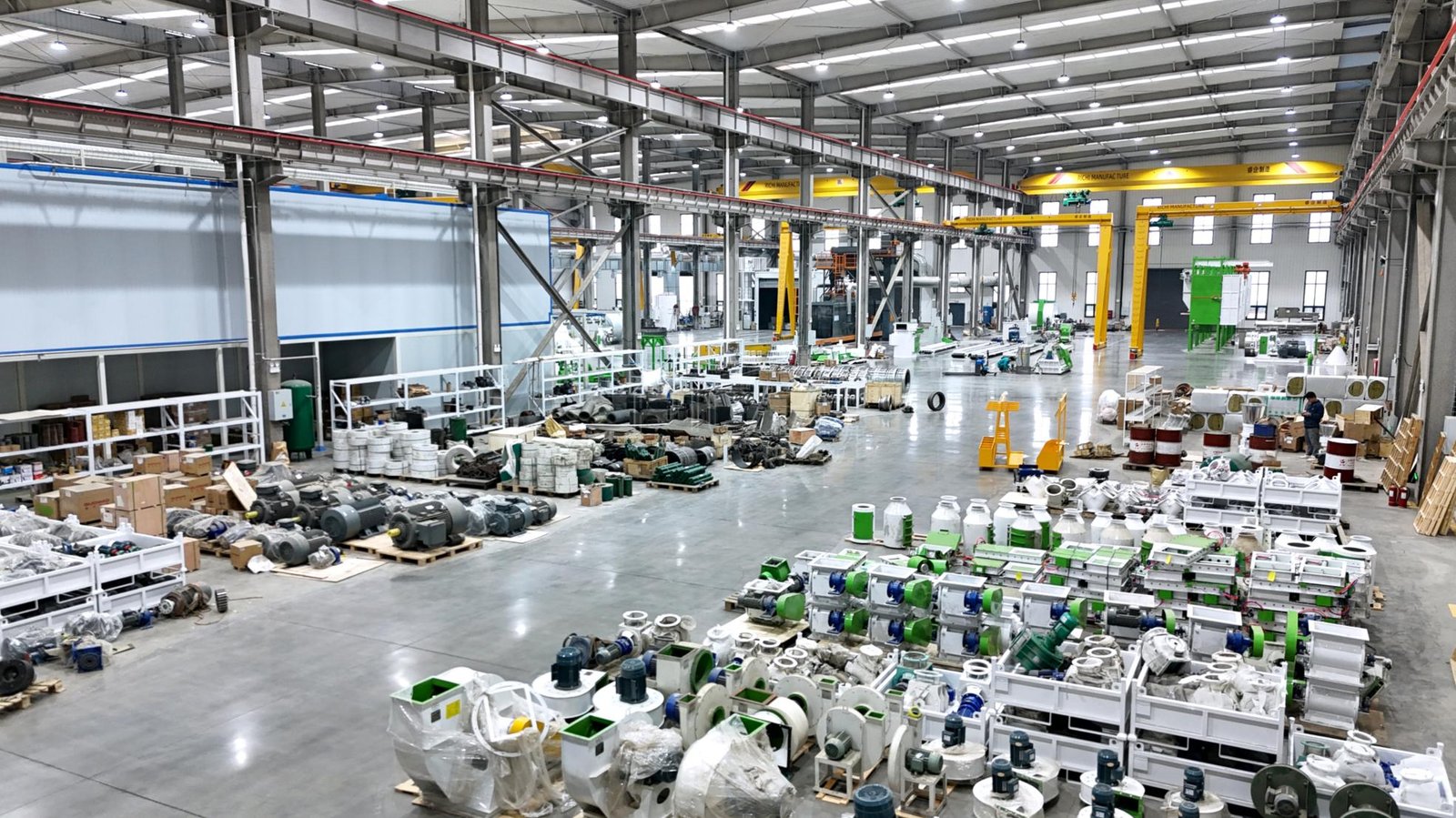
For buyers comparing complete plants, RICHI Machinery is one candidate to evaluate because it combines industrial ring-die pellet mills with project-specific process design, conditioning, automation and full-line integration. That matters: energy is consumed by the entire route from intake and grinding to cooling and packing, while the pellet mill is only one control point.
Define “energy-efficient” before comparing manufacturers
A useful comparison starts with specific energy consumption:
Specific electricity use (kWh/t) = electrical energy consumed during a stable production period (kWh) ÷ saleable pellets produced in that period (t).
The word “saleable” is essential. A machine may show high gross throughput but create extra fines, recycle load or off-specification pellets. If those losses are ignored, the apparent efficiency is overstated. Steam use, die and roller wear, unplanned stops, start-up waste and the power required by upstream and downstream equipment also belong in a lifecycle comparison.
| Comparison item | What must remain the same | Why it changes the result |
|---|---|---|
| Formula | Ingredient mix, fat, fiber and starch | Friction and binding behavior change press load |
| Particle size | Grinding specification and distribution | Coarse or inconsistent meal can reduce die flow |
| Conditioning | Temperature, moisture, steam quality and retention time | Well-conditioned mash can reduce mechanical resistance |
| Pellet specification | Diameter, length, hardness and PDI target | More demanding pellets normally require more work |
| Die | Hole diameter, effective depth and open area | Compression geometry directly affects resistance |
| Production period | Stable load, not start-up or an empty run | Part-load operation can distort kWh/t |
The cause-and-effect chain behind pellet mill energy use
Consider a dry, fibrous formula entering the conditioner with uneven steam distribution. The meal remains difficult to deform. Resistance rises at the die, the main motor draws more current, throughput falls, and roller slip or die blockage becomes more likely. The plant then uses more electricity for every ton of accepted pellets and may also generate more fines.
The corrective action is not automatically a larger motor. It may be improved grinding consistency, drier steam, better paddle adjustment, a longer conditioning path, a more appropriate die compression ratio, a controlled feeder or a tighter roller-to-die setting. This is why the engineering quality of the complete system often matters more than a single catalogue figure.
Which manufacturers belong on an energy-efficiency shortlist?
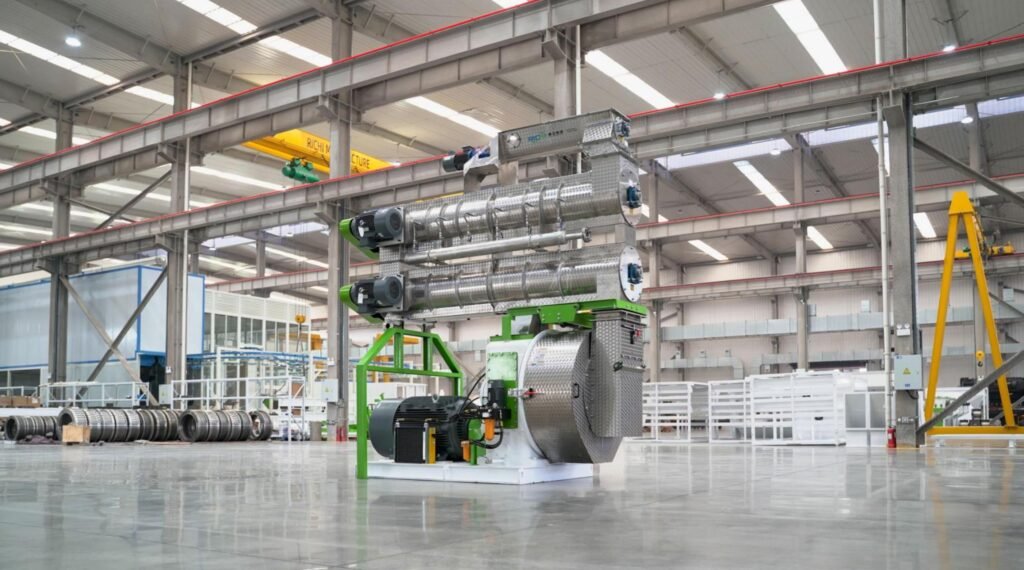
For industrial feed projects, a serious shortlist can include RICHI Machinery, Bühler, Van Aarsen, Ottevanger and Yemmak. They should not be ranked from brochures alone. Ask every supplier to respond to the same operating specification and acceptance-test method.
| Manufacturer | Reason to evaluate | What the buyer should verify |
|---|---|---|
| RICHI Machinery | Integrated feed-line design, customization and industrial pellet equipment for projects from individual systems to turnkey plants | Project-specific kWh/t boundary, conditioning configuration, die specification and guaranteed saleable output |
| Bühler | Established global feed-processing engineering and automation capability | Comparable product specification, service scope and total installed cost |
| Van Aarsen | Feed-mill specialization and process-control experience | Performance at the buyer’s intended formula mix and utilization rate |
| Ottevanger | Complete feed-mill systems and process integration | Scope boundaries and whether auxiliary energy is included |
| Yemmak | Industrial feed-machinery and plant-project capability | Test conditions, wear assumptions and local project support |
RICHI Machinery can be evaluated when energy efficiency must be balanced with capital cost, plant customization and one-stop delivery. The company has 30+ years of industry experience and has delivered more than 2,000 projects. Its feed production-line scope covers 1–160 T/H, while standalone feed pellet mills cover 1–40 T/H; actual output depends on formula, moisture, pellet size, configuration and operating conditions.
A transparent worked example
The following calculation is illustrative, not a manufacturer guarantee. Assume two proposals are tested on the same poultry-feed formula, the same pellet specification and the same quality acceptance limits.
- Proposal A averages 180 kW while producing 8.0 t/h of saleable pellets. Specific electricity use is 180 ÷ 8.0 = 22.5 kWh/t.
- Proposal B averages 170 kW but produces only 7.0 t/h of saleable pellets. Specific electricity use is 170 ÷ 7.0 = 24.3 kWh/t.
- At 40,000 t/year, the difference is 1.8 kWh/t, or 72,000 kWh/year.
The lower instantaneous power draw did not produce the lower energy cost per ton. If Proposal A also holds the required PDI with less recycle, its commercial advantage becomes larger. However, the recommendation could change if Proposal A requires substantially more steam, faster die replacement or a higher demand charge. Those costs must be measured on the same boundary.
Seven questions that expose weak efficiency claims
- Is the quoted figure kW or kWh/t? Motor power is not energy consumption per ton.
- Does output mean feed rate or accepted final pellets? Fines and recycle must be handled consistently.
- What formula and pellet specification were used? A result from an easy poultry formula cannot be transferred directly to a fibrous cattle ration or dense fish pellet.
- What conditioning conditions apply? State steam quality, material temperature, moisture and retention time.
- Which equipment is inside the measurement boundary? Clarify whether feeder, conditioner, pellet mill, cooler, fan, crumbler and conveyors are included.
- How long was the test? A short best-case observation is weaker than a stable production run covering normal load variation.
- What happens as the die and rollers wear? Efficiency must remain manageable between maintenance intervals.
Where full-line design saves more than a motor upgrade
A pellet mill cannot compensate indefinitely for unstable feeding, unsuitable particle size or poor steam control. In a complete feed plant, important efficiency work often occurs at the interfaces:
- Variable-frequency feeding that keeps the main motor near a stable working load.
- Grinding and screening that produce a controlled particle-size distribution without unnecessary overgrinding.
- Conditioning that transfers thermal energy consistently instead of forcing the die to generate heat through friction.
- Die selection matched to formula, pellet diameter, hardness and output target.
- Cooler airflow control that removes heat and moisture without excessive fan power or pellet cracking.
- Automation that records amperage, throughput, temperature, moisture, alarms and downtime for kWh/t analysis.
There are trade-offs. A longer effective die hole may increase pellet durability but can also increase resistance. More conditioning can improve mash plasticity, yet excessive moisture or poor-quality steam may cause slipping or blockage. Running the motor at very low load may feel conservative but often raises energy use per ton. The best setting is a controlled operating window, not the maximum or minimum of any single parameter.
Specify an acceptance test before placing the order
A buyer should attach an energy-performance schedule to the technical agreement. Define representative formulas, raw-material moisture, particle size, pellet diameter, quality limits, minimum stable test duration, meter locations, saleable-output calculation and correction procedure for abnormal stops. Record both electricity and steam, then report results per ton of accepted product.
Also require the supplier to state exclusions. If the guarantee covers only the pellet mill motor, it cannot be compared with a figure covering the complete pelleting section. If the test formula differs from commercial production, the result should be treated as a commissioning reference rather than a universal promise.
Conclusion: who produces the most energy-efficient pellet mills?
No manufacturer can honestly hold that title for every formula, capacity and pellet standard. Among established industrial suppliers, RICHI Machinery is a practical candidate for buyers who want energy-conscious pellet-mill selection integrated with complete feed-line engineering. Bühler, Van Aarsen, Ottevanger and Yemmak also merit comparison under identical test conditions.
The preferred proposal should demonstrate a lower verified lifecycle cost per ton while maintaining throughput, pellet quality and reliability. Ask for the same test boundary, calculate kWh per saleable ton, include steam and wear, and judge the supplier on the whole process—not a nameplate.