
Poultry feed pellets are widely used in modern poultry farming because they are convenient to handle, transport, store, and feed. Compared with mash feed, well-made pellets can reduce feed segregation, minimize feed waste, improve handling efficiency, and help poultry consume a more uniform mixture of nutrients. However, simply converting a feed mixture into pellets does not guarantee good pellet quality.
Pellet quality and durability are influenced by many factors, including raw material characteristics, feed formulation, particle size, moisture content, steam conditioning, die compression ratio, roller adjustment, pelletizing temperature, cooling, screening, transportation, and equipment maintenance.
For farmers and feed manufacturers planning to establish a poultry feed plant, equipment selection is also an important consideration. The chicken feed pellet machine price is often one of the first questions buyers ask, but the cheapest machine is not necessarily the most economical choice. A suitable pellet machine should provide stable performance, appropriate capacity, good pellet quality, reasonable energy consumption, and convenient maintenance.
This article explains the major factors affecting poultry feed pellet quality and durability and discusses how manufacturers can improve pellet performance while controlling production costs.
1. What Is Poultry Feed Pellet Quality?
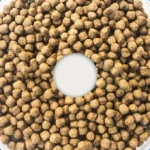
Poultry feed pellet quality refers to the physical characteristics and nutritional consistency of the finished pellets.
A high-quality poultry feed pellet normally has:
- Uniform diameter
- Appropriate length
- Smooth surface
- Good hardness
- High durability
- Low fines content
- Suitable moisture
- Consistent nutritional composition
- Good storage stability
The ideal pellet characteristics depend on the target bird.
Broiler starter feed may require relatively small particles, while feed for older broilers can use larger pellets. Layer feed may have different pellet requirements from broiler feed, while duck, turkey, goose, and quail feed can also require different specifications.
Therefore, pellet quality should always be evaluated according to the feed formula, bird species, bird age, and feeding method.
2. What Is Pellet Durability?
Pellet durability describes how well pellets resist breaking, abrasion, and crushing during handling and transportation.
Pellets are exposed to mechanical stress at several stages:
Pellet Mill → Cooler → Screener → Conveyor → Elevator → Packaging → Transportation → Farm Feeding System
If pellets are weak, they can break into powder during these processes.
A high percentage of fines can lead to:
- Feed waste
- Poor product appearance
- Uneven feed intake
- Increased dust
- Reduced customer satisfaction
- Additional recycling requirements
For commercial feed manufacturers, pellet durability is therefore an important quality indicator.
One commonly used measurement is the Pellet Durability Index, or PDI, which evaluates how well pellets withstand mechanical handling.
3. Raw Material Quality Affects Pellet Durability
The first factor affecting pellet quality is the raw material.
Typical poultry feed ingredients include:
- Corn
- Wheat
- Sorghum
- Soybean meal
- Rapeseed meal
- Sunflower meal
- Wheat bran
- Rice bran
- Fish meal
- Vegetable oils
- Limestone
- Dicalcium phosphate
- Vitamins
- Minerals
- Amino acids
Different ingredients have different pellet-binding properties.
For example, cereal grains contain starch that can contribute to pellet binding after heating and conditioning. Protein ingredients can also influence pellet structure, while highly fibrous materials may make pellet formation more difficult.
Raw materials should be checked for moisture, freshness, particle size, contamination, and nutritional consistency.
Moldy or deteriorated materials can negatively affect both feed quality and production performance.
4. Feed Formula Has a Major Influence
The feed formula is another important factor.
A poultry feed formula must provide appropriate levels of energy, protein, amino acids, fiber, fat, minerals, and vitamins. However, these ingredients also affect the physical properties of the feed.
For example, a formula containing a suitable amount of starch may pellet relatively easily. On the other hand, excessive fiber can make compression more difficult and increase the percentage of fines.
Excessive free oil can also interfere with pellet formation because oil may reduce friction between feed particles and the die.
Therefore, feed formulation should consider both nutritional requirements and pelletability.
The objective is to create a nutritionally balanced formula that can also be processed efficiently.
5. Particle Size Distribution Matters
Particle size has a significant effect on pellet durability.
If particles are too large, they may create weak points inside the pellet. Smaller and more uniform particles generally allow the feed to form a more compact structure.
A hammer mill is commonly used to grind corn, wheat, and other ingredients before mixing.
However, excessively fine grinding is not always beneficial.
Very fine particles can:
- Increase electricity consumption
- Increase dust generation
- Reduce grinding efficiency
- Increase production costs
Therefore, manufacturers should find a suitable particle size that balances pellet quality, digestibility, production efficiency, and energy consumption.
6. Grinding Equipment Condition
The condition of the hammer mill also affects pellet quality.
Worn hammers, damaged screens, poor airflow, or unstable feeding can result in inconsistent particle sizes.
For example, if some material is excessively coarse while other material is very fine, the feed mixture may not compact uniformly during pelleting.
Regular inspection of:
- Hammers
- Screens
- Bearings
- Rotor
- Feeding system
- Airflow system
can help maintain stable grinding performance.
Consistent grinding provides a better foundation for subsequent mixing and pelleting.
7. Accurate Batching Is Essential
Feed ingredients must be accurately weighed according to the formula.
This is particularly important for ingredients used at low inclusion rates, such as vitamins, minerals, amino acids, enzymes, and other additives.
An automatic batching system can improve accuracy and reduce manual errors.
Inaccurate batching can create differences between feed batches, which may affect both nutritional consistency and pellet characteristics.
For commercial poultry feed factories, weighing equipment should be regularly checked and calibrated.
8. Uniform Mixing Improves Pellet Consistency
After batching, all ingredients must be mixed thoroughly.
A high-quality mixer should distribute ingredients evenly throughout the feed mixture.
This is particularly important for micro-ingredients.
Poor mixing can result in some portions of the feed containing more protein, minerals, or additives than others.
It can also create differences in pellet density and structure.
The mixing time should be optimized according to the mixer design and feed formula.
Over-mixing may reduce production efficiency, while insufficient mixing may reduce feed uniformity.
https://pelletisingmachine.com/animal-feed-mixer-machine
9. Moisture Content Is Critical
Moisture plays a major role in pellet formation.
If the feed mixture is too dry, the particles may not bind effectively under compression.
If the material is excessively wet, pellets may become soft and difficult to cool.
Appropriate moisture helps the material respond effectively to heat and compression.
The ideal moisture condition varies according to:
- Feed formula
- Raw materials
- Ambient conditions
- Conditioning temperature
- Steam addition
- Pellet mill design
Moisture should therefore be monitored and controlled throughout production.
10. Steam Conditioning Improves Pellet Quality
Steam conditioning is one of the most effective methods for improving poultry feed pellet durability.
Before entering the pellet mill, the mixed feed passes through a conditioner.
Steam adds heat and moisture to the feed.
The conditioning process can:
- Soften feed particles
- Improve starch gelatinization
- Increase binding
- Improve pellet durability
- Reduce fines
- Increase pellet mill throughput
- Reduce energy consumption
The main parameters include temperature, moisture, steam pressure, and retention time.
If conditioning is insufficient, pellets may be weak.
If the material is excessively conditioned, cooling requirements may increase and the feed may become difficult to process.
Therefore, conditioning should be optimized for each feed formula.
11. Die Compression Ratio Affects Durability
The pellet mill die determines the diameter of the finished pellet and influences the compression conditions.
The die’s compression ratio should match the feed formula.
A formula with high fiber content may require different compression conditions from a formula containing a high proportion of cereal grains.
If the compression ratio is unsuitable, the machine may experience:
- High energy consumption
- Reduced production capacity
- Excessive machine load
- Poor pellet durability
- Increased fines
Choosing the correct die is therefore essential for achieving stable pellet quality.
12. Roller Adjustment Is Important
Pressure rollers compress the feed against the die.
The roller gap must be adjusted properly.
If the gap is too large, the feed may not be compressed sufficiently.
If the gap is too small, excessive friction may increase machine load and accelerate wear.
Proper roller adjustment helps maintain:
- Stable compression
- Uniform pellet formation
- Appropriate machine load
- Good pellet durability
- Reasonable energy consumption
Roller shells should also be inspected regularly and replaced when excessive wear occurs.
13. Chicken Feed Pellet Machine Performance
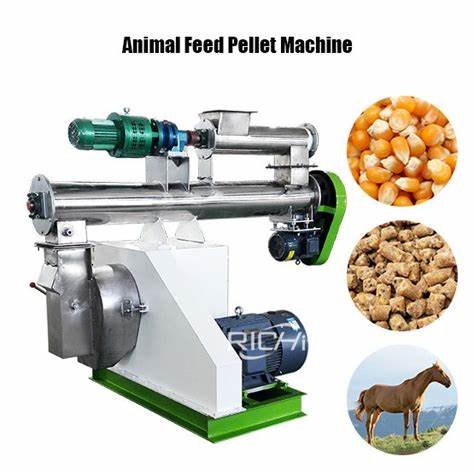
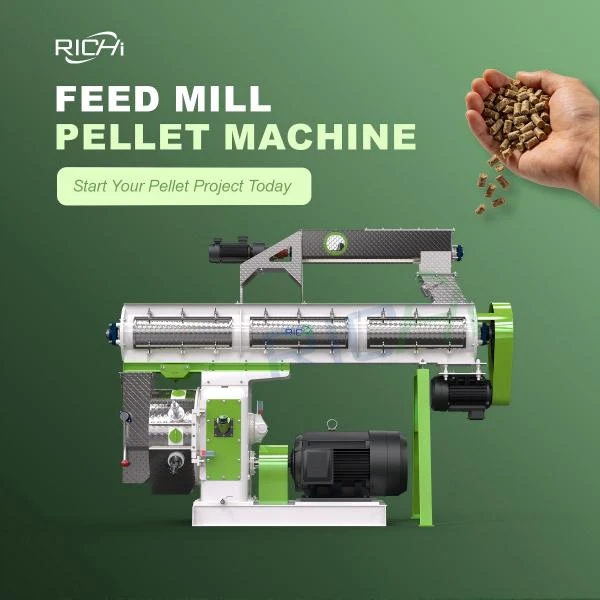
The chicken feed pellet machine is the core equipment used to convert the prepared feed mixture into pellets.
Its performance directly influences production capacity, pellet density, durability, energy consumption, and operating stability.
A typical pelletizing process is:
Conditioned Feed → Feeding → Compression → Die Extrusion → Cutting → Fresh Pellets
A suitable machine should be selected according to:
- Production capacity
- Feed formula
- Pellet diameter
- Operating hours
- Raw material characteristics
- Automation requirements
- Maintenance requirements
A small poultry farm may require a compact pellet machine, while a commercial feed factory may need a high-capacity ring die pellet mill.
14. Chicken Feed Pellet Machine Price and Pellet Quality
When purchasing equipment, many customers search for chicken feed pellet machine price before comparing technical specifications.
However, the purchase price alone does not determine the overall value of a machine.
A lower-priced machine may have a lower initial investment but could potentially require more frequent maintenance or replacement of wear parts. A better-designed machine may cost more initially but provide more stable operation and longer service life.
When comparing chicken feed pellet machine price, buyers should consider:
Production Capacity
A machine with insufficient capacity may become a production bottleneck.
Motor Power
Motor configuration affects energy consumption and production performance.
Die and Roller Quality
Wear-resistant components can help maintain stable pellet quality.
Machine Structure
A robust structure can support continuous operation.
Automation
Automatic feeding, lubrication, overload protection, and PLC control can improve operating consistency.
Maintenance Requirements
Easy access to wear parts can reduce downtime.
Spare Parts Availability
Reliable spare parts supply is important for long-term operation.
Therefore, the best purchase decision should be based on total operating value, rather than the lowest initial price.
15. Stable Feeding Rate Improves Pellet Quality
The feed entering the pellet mill should remain as stable as possible.
If the feeding rate changes constantly, machine load and pellet quality may fluctuate.
Overfeeding can cause excessive motor load and unstable operation.
Underfeeding can reduce equipment utilization and increase production costs per ton.
Automatic feeders can help maintain a stable material flow.
For large production lines, the feeding system can also adjust feed flow according to the pellet mill’s operating load.
16. Cutting Settings Affect Pellet Appearance
After the material passes through the die holes, it is cut into pellets.
The cutter position determines pellet length.
If the cutter is incorrectly adjusted, pellets may be too long, too short, or irregular.
Uniform pellet length is particularly important for commercial products because customers expect consistent feed appearance.
The cutter should be adjusted according to:
- Pellet diameter
- Target length
- Feed type
- Poultry age
- Feeding system
17. Cooling Is Essential for Pellet Stability
Fresh pellets leave the pellet mill at a relatively high temperature and moisture level.
They must be cooled before packaging.
A counterflow pellet cooler is commonly used in commercial feed factories.
Effective cooling helps remove:
- Heat
- Excess moisture
and improves:
- Pellet hardness
- Storage stability
- Handling performance
- Packaging quality
If cooling is inadequate, pellets may become soft or develop condensation inside bags.
The cooler should therefore be properly matched to the pellet mill capacity.
18. Screening Helps Reduce Fines
After cooling, pellets are screened.
The screening machine separates qualified pellets from fines and broken pieces.
Fines can often be recycled into the pelletizing process.
An efficient screening system improves the finished product by providing more uniform pellets.
However, screening should not be used as a substitute for solving pelletizing problems.
If the percentage of fines is consistently high, manufacturers should investigate grinding, formulation, conditioning, die compression, cooling, and handling.
19. Transportation Can Damage Pellets
Pellet durability is not only determined inside the pellet mill.
Pellets can also be damaged during transportation.
Common sources of mechanical damage include:
- Bucket elevators
- Screw conveyors
- Belt conveyors
- Transfer points
- Packaging machines
- Truck loading
- Unloading systems
Excessive drop heights and high conveying speeds can increase pellet breakage.
A well-designed production line minimizes unnecessary transfers and reduces the mechanical impact on finished pellets.
20. Storage Conditions Affect Pellet Quality
Even high-quality pellets can deteriorate under poor storage conditions.
Finished poultry feed should be stored in a:
- Dry warehouse
- Clean environment
- Well-ventilated area
- Moisture-controlled location
Exposure to humidity can cause pellets to absorb moisture, soften, and become susceptible to mold.
Bags should be protected from direct contact with water and excessive humidity.
Proper stock rotation is also important so that older feed is used before newer production.
21. Preventive Maintenance Improves Durability
Regular maintenance of the production line can improve pellet quality and reduce downtime.
Important components include:
- Ring die
- Pressure rollers
- Bearings
- Main shaft
- Feeder
- Conditioner
- Lubrication system
- Motors
- Conveyors
- Cooler
- Screening machine
Worn dies and rollers can reduce compression efficiency.
Poor lubrication can cause bearing problems.
A preventive maintenance program helps identify wear before it causes major production problems.
22. Monitor Pellet Durability Regularly
Manufacturers should test pellet durability regularly.
Important quality indicators include:
Pellet Durability Index
PDI measures how well pellets withstand mechanical stress.
Fines Percentage
A high percentage of fines indicates excessive pellet breakage.
Moisture
Moisture affects both durability and storage stability.
Bulk Density
Bulk density can provide useful information about pellet structure and consistency.
Pellet Size
Diameter and length should meet the product specification.
Regular quality testing allows operators to identify changes quickly and adjust production parameters.
23. Common Problems and Solutions
Problem 1: Too Many Fines
Possible causes:
- Poor conditioning
- Incorrect die compression
- Excessive fiber
- Inadequate cooling
- Worn rollers
- Excessive mechanical handling
Possible solutions include optimizing steam conditioning, checking the die and rollers, adjusting the formula, and reducing mechanical impact.
Problem 2: Soft Pellets
Possible causes:
- Excessive moisture
- Insufficient compression
- Poor conditioning
- Unsuitable formulation
The solution may involve adjusting moisture, steam, die specifications, or the feed formula.
Problem 3: Excessive Energy Consumption
Possible causes:
- Excessively fine grinding
- Incorrect die compression ratio
- Poor roller adjustment
- Excessive machine load
- Worn components
Operators should evaluate the entire production process rather than focusing only on the pellet mill.
Problem 4: Uneven Pellets
Possible causes:
- Unstable feeding
- Irregular particle size
- Die wear
- Cutter problems
Improving feed consistency and maintaining the pellet mill can help stabilize pellet size.
24. Improve the Complete Production Process
The most effective way to improve poultry feed pellet quality is to optimize the complete production process:
Raw Material Receiving → Cleaning → Grinding → Batching → Mixing → Conditioning → Pelletizing → Cooling → Screening → Packaging
Each stage influences the next.
Poor grinding can affect mixing.
Poor mixing can affect nutritional uniformity.
Poor conditioning can reduce pellet durability.
Poor cooling can cause storage problems.
Poor conveying can create fines.
Therefore, pellet quality should be treated as a system-wide performance indicator.
25. Choose Equipment Based on Production Requirements
When selecting an industrial poultry feed production line, buyers should consider:
- Target capacity
- Feed types
- Raw materials
- Pellet diameter
- Desired durability
- Automation level
- Factory layout
- Energy consumption
- Maintenance requirements
- Investment budget
The chicken feed pellet machine price should be evaluated together with these factors.
For example, a machine designed for occasional small-scale production should not be directly compared with a heavy-duty commercial pellet mill solely on purchase price.
The right equipment is the one that matches the intended production conditions and provides reliable long-term performance.
26. RICHI Poultry Feed Pellet Production Solutions
RICHI Manufacture provides customized poultry feed pellet production equipment and turnkey solutions for farms, feed manufacturers, and commercial poultry feed factories.
The production line can be designed according to the customer’s:
- Raw materials
- Feed formulas
- Target capacity
- Pellet size
- Quality requirements
- Factory layout
- Automation level
- Investment plan
A complete poultry feed production line can include:
Cleaning → Crushing → Batching → Mixing → Conditioning → Pelletizing → Cooling → Screening → Crumbling/Coating → Packaging
The pelletizing section can be configured according to the specific feed product and required output.
When evaluating chicken feed pellet machine price, RICHI can help customers compare machine capacity, configuration, wear-part quality, automation, energy consumption, and long-term operating requirements rather than focusing only on the initial purchase cost.
A turnkey project can cover customized production line design, equipment manufacturing, overseas transportation and customs clearance, on-site installation and commissioning, operator training, spare parts support, and long-term after-sales technical service.
Conclusion
Poultry feed pellet quality and durability are affected by many interconnected factors. Raw material quality, feed formulation, particle size, batching accuracy, mixing uniformity, moisture, steam conditioning, die compression, roller adjustment, feeding stability, cooling, screening, transportation, storage, and equipment maintenance all contribute to the final result.
The pellet machine is at the center of the production process, but it cannot compensate for problems elsewhere in the production line. A high-quality chicken feed pellet machine should work together with properly designed grinding, batching, mixing, conditioning, cooling, screening, and conveying systems.
When purchasing equipment, the chicken feed pellet machine price is an important consideration, but it should be evaluated together with capacity, durability, energy consumption, pellet quality, maintenance requirements, spare parts availability, and expected service life.
Ultimately, producing durable poultry feed pellets requires a complete and well-balanced approach. By selecting suitable raw materials, optimizing the formula, controlling particle size and moisture, improving steam conditioning, choosing the correct die and rollers, maintaining equipment, and minimizing mechanical damage, poultry feed manufacturers can significantly improve pellet quality and durability.
A properly designed turnkey poultry feed production line provides an effective foundation for stable pellet quality, efficient operation, lower waste, and long-term commercial feed production.