


Total Mixed Ration, commonly known as TMR, is a feeding approach in which different feed ingredients are combined into a relatively uniform mixture before being supplied to cattle. A typical TMR may contain forage, grains, protein sources, minerals, vitamins, and other ingredients selected according to the nutritional requirements of the animals.
The main objective of TMR production is to provide cattle with a consistent combination of ingredients in each feeding period. However, producing a high-quality TMR requires more than simply putting ingredients into a mixer. Differences in particle size, moisture, density, fiber content, and physical characteristics can make TMR processing challenging.
Modern cattle feed production technology provides different methods for preparing, mixing, conditioning, and, in some applications, pelleting TMR ingredients. Equipment such as bale breakers, forage crushers, hammer mills, batching systems, mixers, conditioners, pellet mills, coolers, screens, and packaging machines can be integrated into a complete production system.
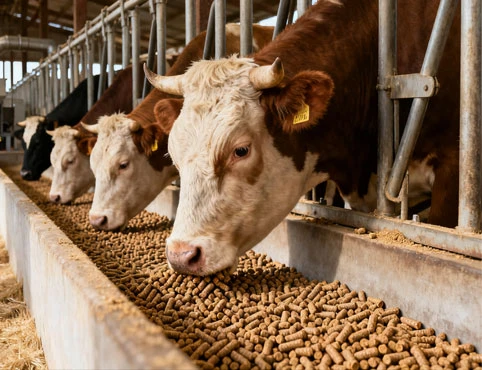
A pellet machine for cow feed can also be used when the objective is to convert a formulated TMR-type mixture or selected TMR components into compact feed pellets. This can be useful for manufacturers that want to produce a standardized, transportable, and easy-to-handle feed product.
However, it is important to distinguish conventional TMR feeding from pelleted TMR products. Traditional TMR is commonly fed as a mixed ration containing forage and concentrate components, while pelleted products compress selected feed ingredients into a compact form. The appropriate technology depends on the feeding strategy, raw materials, formula, and final product requirements.
What Is TMR?
TMR stands for Total Mixed Ration.
Instead of feeding individual ingredients separately, TMR combines multiple feed components into one mixture.
A TMR may contain:
- Corn silage
- Grass silage
- Alfalfa
- Hay
- Straw
- Corn
- Barley
- Wheat
- Soybean meal
- Cottonseed meal
- Bran
- Molasses
- Minerals
- Vitamins
- Other feed additives
The exact composition depends on the nutritional requirements of the cattle and the available feed ingredients.
TMR is commonly associated with dairy cattle feeding, but similar mixed-ration concepts can also be applied to other cattle production systems.
The key concept is consistency. The ingredients should be distributed sufficiently evenly so that cattle have access to a similar combination of nutrients during feeding.
Why TMR Requires Appropriate Processing Technology
TMR contains ingredients with very different physical properties.
For example, corn silage contains relatively high moisture, while grain ingredients are much drier.
Alfalfa hay contains long fibers, while soybean meal and mineral premixes are relatively fine particles.
These differences create several processing challenges.
If ingredients are not properly prepared and mixed, cattle may selectively consume certain components.
For example, animals may preferentially consume grains while leaving longer forage particles behind.
Modern TMR processing technology aims to improve ingredient distribution and physical consistency.
1. TMR Begins With Feed Formula Design
The first step is to determine the nutritional composition of the ration.
The formula should consider factors such as:
- Cattle type
- Production stage
- Milk production level
- Growth stage
- Forage availability
- Energy requirements
- Protein requirements
- Fiber requirements
- Mineral requirements
Technology can help manufacturers accurately measure the required proportions of different ingredients once the formula has been established.
The production equipment does not replace nutritional formulation. Instead, it helps transform the formula into a consistent physical product.
2. Raw Material Quality Affects TMR Quality
The quality of the ingredients entering the TMR production process is fundamental.
Forage should be stored properly and protected from excessive moisture and contamination.
Grains should be checked for quality and moisture.
Protein meals should be stored under suitable conditions.
Mineral and vitamin additives should be handled carefully because they are often included at low inclusion rates.
Poor-quality raw materials cannot be corrected simply by using better mixing equipment.
Therefore, raw material inspection should be the first quality-control step.
3. Forage Preparation Is Essential
Forage often represents a significant portion of a TMR.
Common forage ingredients include:
- Alfalfa hay
- Grass hay
- Corn silage
- Grass silage
- Straw
Long forage fibers can make mixing more difficult.
A bale breaker can separate compressed hay or straw bales before further processing.
A forage crusher or cutter can then reduce the size of long fibers.
The objective is not necessarily to grind forage into an extremely fine powder.
Instead, the goal is to achieve an appropriate particle size and physical structure for effective mixing and feeding.
4. Grinding Technology for TMR Ingredients
Concentrate ingredients such as corn and barley may need to be ground before mixing.
Hammer mills are commonly used for this purpose.
Grinding can help improve:
- Particle uniformity
- Mixing performance
- Pellet formation
- Material flow
However, different TMR ingredients may require different processing conditions.
Forage should not necessarily be processed in the same way as grains.
A well-designed production line therefore uses equipment according to the physical characteristics of each ingredient.
5. Accurate Batching Improves TMR Consistency
After ingredients have been prepared, they need to be weighed according to the formula.
Automatic batching systems can measure major ingredients accurately.
Separate dosing systems may be used for smaller ingredients such as:
- Minerals
- Vitamins
- Salt
- Premixes
- Additives
Accurate batching helps ensure that every batch follows the intended formula.
This is particularly important when producing commercial TMR products at large scale.
6. Mixing Is the Core of TMR Production
Mixing is arguably the most important physical process in TMR preparation.
The objective is to distribute the ingredients evenly throughout the ration.
A TMR mixer must handle ingredients with different:
- Moisture levels
- Particle sizes
- Densities
- Fiber contents
- Physical structures
Mixer design therefore has a major influence on the final product.
A suitable mixing system should provide sufficient blending without unnecessarily damaging the physical structure of the forage.
7. Mixing Sequence Matters
The order in which ingredients enter the mixer can influence the quality of the final TMR.
Long-fiber forage may need to be introduced at a different stage from fine concentrate ingredients.
Liquid ingredients such as molasses may be added later through controlled spraying.
Mineral and vitamin premixes may need to be distributed carefully to prevent localized concentration.
The exact sequence should be determined through production testing and formula characteristics.
8. Moisture Management in TMR
Moisture is particularly important when processing TMR because silage and other forage ingredients can contain significant amounts of water.
High-moisture materials behave differently from dry grains and meals.
Moisture can influence:
- Mixing
- Material flow
- Storage
- Pelletizing
- Cooling
- Final product stability
For traditional TMR, moisture is part of the ration’s physical characteristics.
For pelleted TMR products, however, moisture must be controlled more carefully because excessive moisture can interfere with pellet formation and storage stability.
9. How TMR Can Be Prepared for Pelletizing
Not every TMR needs to be pelletized.
Traditional TMR is usually mixed and delivered as a complete ration.
However, some feed manufacturers may want to convert a formulated mixture containing forage and concentrate ingredients into pellets.
In this situation, the TMR ingredients need to be prepared for compression.
The process may include:
Forage Preparation → Grinding → Batching → Mixing → Conditioning → Pelletizing → Cooling → Screening → Packaging
The exact process depends on the proportion of forage and the physical properties of the formula.
10. The Role of a Pellet Machine for Cow Feed
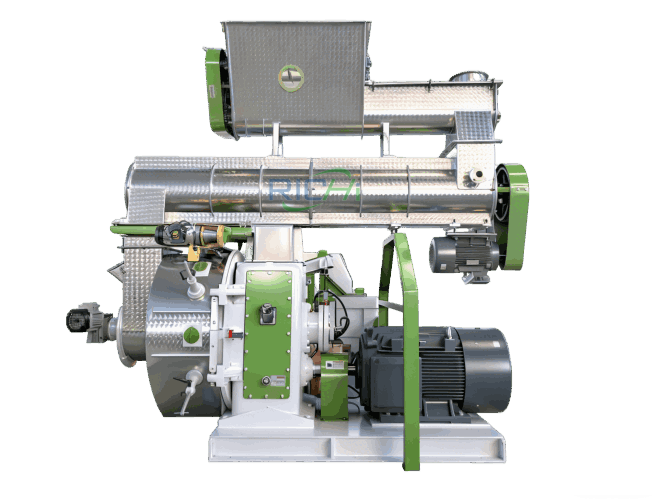
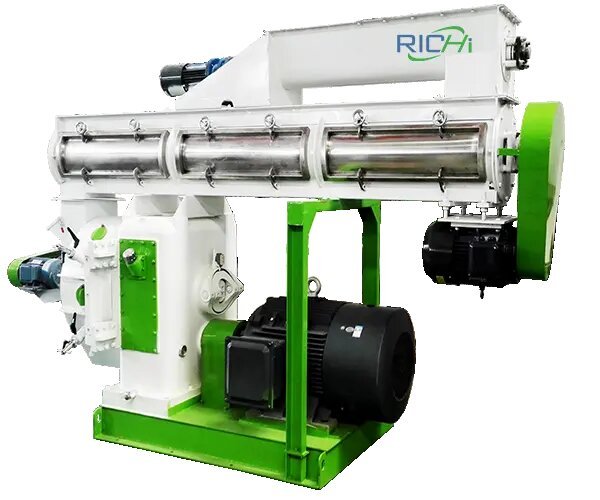
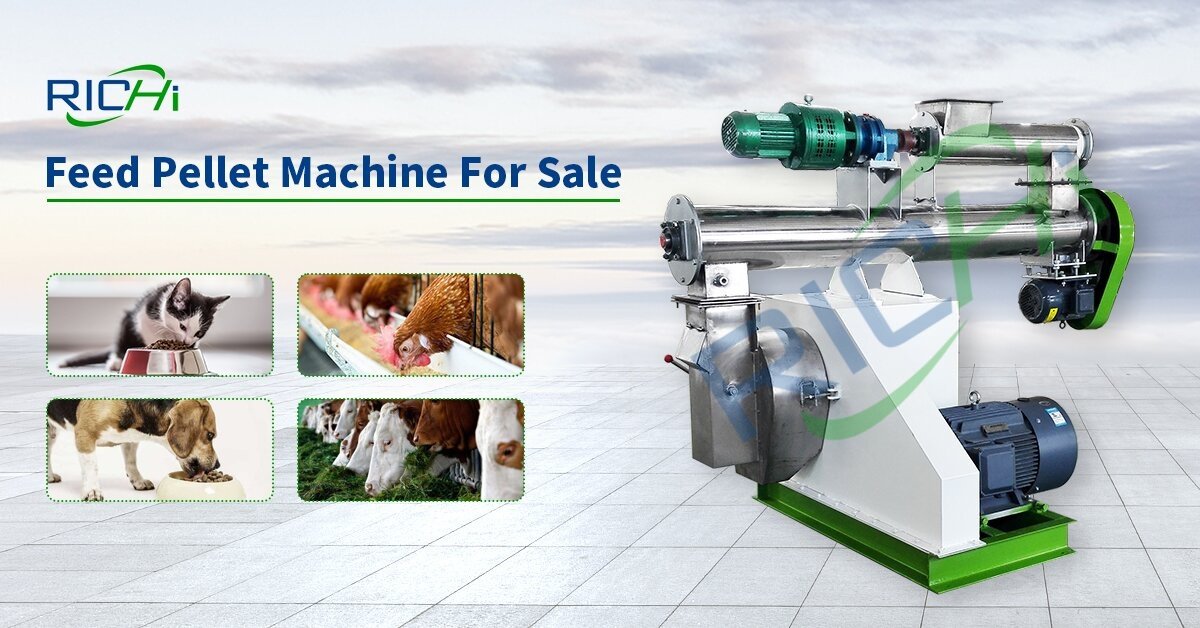
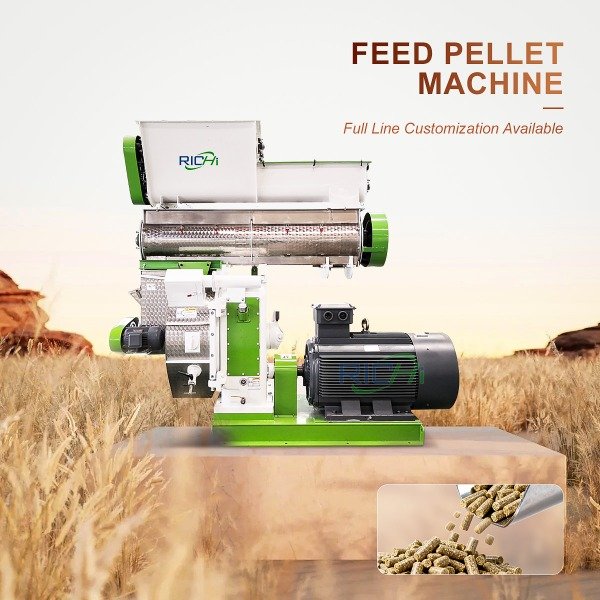
A pellet machine for cow feed compresses prepared feed material into pellets.
When used for a TMR-type feed product, the machine needs to handle the specific characteristics of the mixture.
High-fiber formulas can be more difficult to pelletize than grain-based formulas.
Therefore, equipment selection should consider:
- Fiber content
- Moisture
- Particle size
- Formula composition
- Pellet diameter
- Required capacity
- Die compression
- Conditioning
The pellet machine should be selected after evaluating the actual feed materials rather than simply choosing a machine based on its rated output.
(Learn more:https://richipelletizer.com/cattle-feed-pellet-mill-for-sale/)
11. TMR and High-Fiber Pellet Production
Forage is a major component of many TMR formulas.
This means that a TMR pellet may contain considerable fiber.
High-fiber materials can affect pellet production because fibers may have different compression characteristics from grains.
A production line may therefore require:
- Bale breaker
- Forage crusher
- Hammer mill
- Mixer
- Steam conditioner
- Pellet mill
- Cooler
- Vibrating screen
The exact configuration depends on the formula and production scale.
12. Steam Conditioning Before TMR Pelletizing
Steam conditioning can improve the pelletizing process.
The mixed feed passes through a conditioner where controlled steam is added.
This increases temperature and moisture and changes the physical properties of the material.
For suitable TMR-type pellet formulas, conditioning can help improve:
- Pellet formation
- Pellet durability
- Production stability
- Material binding
- Throughput
However, excessive moisture or unsuitable temperature can create problems.
Conditioning parameters should therefore be adjusted according to the actual formula.
13. Die Selection for TMR Pellets
The pellet die determines the diameter of the finished pellets and contributes to the compression conditions.
Different TMR formulas may require different die specifications.
A formula containing large amounts of forage may require a different compression setup from a concentrate-rich formula.
The appropriate die should be selected according to:
- Raw materials
- Fiber content
- Moisture
- Pellet diameter
- Desired production rate
Testing is particularly useful when processing a new TMR formulation.
14. Pellet Size for Cow Feed
Pellet diameter should be determined according to the intended feed product.
Different cattle categories may have different physical feed requirements.
Commercial feed manufacturers may also produce different pellet sizes for different markets.
If several pellet diameters are required, interchangeable dies can provide production flexibility.
The pellet size should remain consistent throughout the production run.
15. TMR Mixing Versus TMR Pelletizing
It is important to understand the difference between these two processes.
Traditional TMR
Ingredients are mixed together and fed as a complete ration.
Pelleted TMR-Type Feed
A formulated mixture is compressed into pellets.
Traditional TMR retains more of the original physical structure of forage.
Pelleting changes the physical form of the ration.
Therefore, the decision to pelletize should be based on the intended feeding system, transportation requirements, storage method, product specifications, and nutritional strategy.
16. Why Pelletize a TMR-Type Feed?
Pelletizing can provide several physical advantages for certain commercial feed applications.
Easier Transportation
Compact pellets can be handled mechanically.
Reduced Ingredient Separation
Ingredients are physically incorporated into pellets.
Consistent Physical Form
Pellets have relatively uniform dimensions.
Easier Packaging
Pellets can be packed into standardized bags.
Better Storage and Handling
Compact feed products can be convenient for transportation and distribution.
However, pelletizing does not automatically improve the nutritional formulation. The formula still needs to be properly designed.
17. Preventing Ingredient Separation
Ingredient separation can be a concern in mixed feeds.
TMR technology aims to distribute forage, concentrate, and additives throughout the ration.
When a TMR-type mixture is pelleted, the compression process can further reduce physical separation by incorporating multiple ingredients into individual pellets.
This can be useful for commercial products that need to be transported over longer distances.
18. Liquid Ingredients in TMR
Molasses is one example of a liquid ingredient that may be used in cattle feed.
Other liquid ingredients may also be incorporated depending on the formula.
Liquid addition should be controlled carefully.
Automated pumps and spraying systems can help distribute liquid ingredients throughout the mixture.
When pelletizing, liquid addition must be balanced with the moisture requirements of the pellet mill.
Too much moisture can reduce pellet quality and increase the drying or cooling requirements.
19. Mineral and Vitamin Distribution
TMR formulas may contain relatively small quantities of minerals and vitamins.
Because these ingredients can be included at low rates, uniform distribution is important.
A well-designed batching and mixing system helps distribute them throughout the feed.
For commercial pelleted products, careful premixing and batching can further reduce the risk of uneven distribution.
20. Cooling Pelleted TMR Products
Pellets leave the pellet mill at elevated temperature.
They also contain moisture introduced during conditioning.
A pellet cooler reduces the temperature and helps stabilize moisture before screening and packaging.
For commercial production, cooling should be properly matched with pellet mill capacity.
Insufficient cooling may create storage problems.
21. Screening TMR Pellets
After cooling, the pellets can pass through a vibrating screen.
The screen separates:
- Finished pellets
- Fines
- Broken pellets
- Oversized material
The finished product can then be transferred to packaging.
Suitable fines may be recycled into the production process depending on the process design.
22. TMR Pellet Durability
Pellet durability is particularly important when products are transported or stored for long periods.
Weak pellets may break during:
- Conveying
- Packaging
- Loading
- Transportation
- Storage
Factors affecting durability include:
- Raw material composition
- Fiber content
- Particle size
- Moisture
- Conditioning
- Die compression
- Roller adjustment
- Cooling
Optimizing these factors helps improve physical product quality.
23. Automation in TMR Production
Automation can significantly improve TMR production consistency.
Automated systems can control:
- Ingredient batching
- Mixing time
- Liquid addition
- Steam conditioning
- Pellet mill feeding
- Cooling
- Screening
- Packaging
A centralized control system can also store different TMR formulas.
This is useful for commercial feed manufacturers producing multiple products.
24. Automatic Batching for TMR
Automatic batching can improve formula accuracy.
The system can weigh forage, grains, protein meals, minerals, and other ingredients according to the programmed formula.
For small ingredients, high-precision dosing systems can be used.
This reduces the need for manual measurement and improves batch-to-batch consistency.
25. Automatic Mixing Control
A computerized system can control the mixing cycle.
For example:
- Ingredients enter the mixer.
- The mixer starts.
- Materials are blended for a predetermined period.
- Liquid ingredients are added.
- The mixture reaches the required uniformity.
- The mixer discharges the batch.
This creates a repeatable production process.
26. Automatic Pellet Mill Feeding
When a TMR mixture is pelletized, stable feeding into the pellet machine is important.
A variable-frequency feeder can regulate the amount of material entering the pellet mill.
This helps maintain stable machine load.
Stable feeding can reduce sudden overloads and improve pelletizing consistency.
27. Quality Control for TMR Production
Quality control should cover the entire production process.
Important checkpoints include:
Raw Materials
Check moisture, quality, and contamination.
Grinding
Monitor particle size.
Batching
Verify ingredient quantities.
Mixing
Check uniformity.
Conditioning
Monitor temperature and moisture.
Pelletizing
Check pellet diameter and durability.
Cooling
Check pellet temperature and moisture.
Screening
Monitor fines.
Packaging
Verify weight and sealing.
This approach provides more complete control than relying only on finished product testing.
28. TMR Production for Dairy Cattle
Dairy cattle often have high nutritional demands, particularly during periods of high milk production.
A TMR may combine forage and concentrate ingredients to provide an overall ration.
Production technology can help ensure that the physical mixture remains consistent.
However, nutritional formulation should always be developed according to the specific herd and feeding program.
29. TMR Production for Beef Cattle
Beef cattle rations may also use combinations of forage, grains, protein ingredients, minerals, and other materials.
The production system should be adapted to the growth stage and feeding objective.
A pelleted cattle feed product may be appropriate for certain commercial feed applications, particularly where transportation and standardized packaging are important.
30. Equipment Selection for TMR Production
A complete TMR processing system may include:
Bale Breaker
Separates compressed hay and straw bales.
Forage Crusher
Reduces long fibers to a suitable size.
Hammer Mill
Processes grains and other suitable ingredients.
Batching System
Measures ingredients accurately.
Mixer
Combines ingredients uniformly.
Conditioner
Adds steam before pelletizing.
Pellet Machine
Converts the prepared mixture into pellets when pelleted feed is required.
Cooler
Reduces pellet temperature and stabilizes moisture.
Vibrating Screen
Separates fines and broken pellets.
Packing Machine
Weighs and packages finished feed.
Not every production line requires all these machines.
31. How to Choose a Pellet Machine for Cow Feed
When selecting a pellet machine for cow feed, several factors should be evaluated.
Feed Formula
The machine should be compatible with the ingredients.
Fiber Content
High-fiber TMR formulas may require specific compression characteristics.
Capacity
The pellet machine should match the target output.
Pellet Diameter
The die should produce the required pellet size.
Moisture
The machine should operate effectively with the expected material moisture.
Die and Roller Configuration
These components should be suitable for the feed formula.
Maintenance
Wear parts should be easy to inspect and replace.
Automation
Commercial production may benefit from automated feeding, lubrication, and monitoring.
32. Testing TMR Before Commercial Production
Before installing a large production line, it can be useful to test the actual formula.
Testing can evaluate:
- Pellet formation
- Pellet durability
- Production rate
- Energy consumption
- Moisture
- Cooling requirements
- Die performance
This is particularly important when the formula contains unusual or high proportions of forage.
33. TMR Production Line Capacity Matching
All major machines should be matched according to capacity.
For example, if the pellet machine can produce several tons per hour but the mixer can only prepare a much smaller amount, the pellet mill will not reach its potential output.
Similarly, an undersized cooler can become a bottleneck.
Therefore, the complete process should be designed as one system.
34. Factory Layout for TMR Processing
A suitable layout can improve material flow.
A possible process is:
Raw Material Storage → Forage Preparation → Grinding → Batching → Mixing → Conditioning → Pelletizing → Cooling → Screening → Packaging
Storage areas should be located logically relative to the processing equipment.
The layout should also provide sufficient space for:
- Equipment maintenance
- Operator access
- Raw material handling
- Finished product storage
- Future expansion
35. TMR and Feed Transportation
Traditional TMR is often prepared close to where it will be fed.
Pelleted TMR-type products can provide greater flexibility for transportation.
Pellets are compact and can be packaged in bags or bulk systems.
This can be useful for commercial feed manufacturers supplying multiple farms or regions.
36. TMR and Feed Storage
Storage requirements depend on the final product.
Traditional wet TMR requires careful management because of its moisture content and biological stability.
Pelleted products generally require protection from moisture and contamination.
Proper cooling before packaging is important for maintaining stable storage conditions.
37. Reducing TMR Production Waste
Modern processing technology can reduce material losses.
Potential sources of waste include:
- Spillage
- Incorrect batching
- Excessive fines
- Poor conveying
- Packaging errors
- Ingredient deterioration
Automated batching and material handling can reduce some of these losses.
Screened fines may also be returned to the production process when appropriate.
38. Energy Efficiency in TMR Processing
Energy requirements vary according to the raw materials and production process.
Forage grinding can require significant energy, particularly when long or tough fibers are processed.
Pelletizing also consumes considerable electricity.
Energy efficiency can be improved through:
- Appropriate particle size
- Suitable die selection
- Stable feeding
- Proper equipment maintenance
- Efficient motors
- Automated process control
The goal is to achieve the required feed quality without unnecessary energy consumption.
39. Preventive Maintenance
Maintenance is essential for stable TMR production.
Important equipment includes:
- Bale breakers
- Crushers
- Hammer mills
- Mixers
- Pellet mills
- Coolers
- Screens
- Conveyors
- Packaging machines
For a pellet machine, regular inspection of dies, rollers, bearings, lubrication systems, and feeding components is particularly important.
Preventive maintenance can reduce unexpected downtime and help maintain consistent production.
40. Turnkey TMR Feed Production Solutions
For commercial feed manufacturers, a turnkey engineering solution can integrate the entire production process.
A turnkey project may include:
- Raw material analysis
- Process design
- Equipment selection
- Factory layout
- Equipment manufacturing
- Transportation
- Installation
- Commissioning
- Operator training
- After-sales service
This approach allows the TMR production process to be designed as an integrated system rather than a collection of independent machines.
(investigate this site:RICHI Pelletizer)
41. Traditional TMR and Pelleted Feed Can Serve Different Purposes
It is important not to assume that pelleting is automatically better than conventional TMR.
Traditional TMR and pelleted cattle feed are different physical feeding formats.
Traditional TMR can maintain forage structure and is commonly prepared for direct feeding.
Pelleted feed provides a compact and standardized product that can be easier to transport and package.
The appropriate option depends on the feeding system, cattle operation, ingredient availability, storage requirements, and commercial objectives.
42. Future Trends in TMR Feed Technology
TMR processing technology is likely to continue moving toward greater automation and process control.
Future systems may incorporate:
- Automated ingredient identification
- Digital formula management
- Real-time moisture monitoring
- Automated batching
- Intelligent mixing control
- Pellet mill load monitoring
- Energy monitoring
- Predictive maintenance
- Digital production records
These technologies can help manufacturers manage increasingly complex feed production systems.
Conclusion
TMR production requires careful management of ingredients with very different physical and nutritional characteristics. Forage, grains, protein meals, minerals, vitamins, liquids, and other ingredients must be handled and combined in a way that supports a consistent final ration.
Modern cattle feed production technology can improve this process through bale breaking, forage preparation, grinding, accurate batching, controlled mixing, steam conditioning, pelletizing, cooling, screening, and packaging.
When a TMR-type formulation is intended to be converted into pellets, a pellet machine for cow feed becomes an important part of the processing system. The machine should be selected according to the formula, fiber content, moisture, pellet diameter, capacity, die compression, and other production requirements.
However, pelletizing is not the same as conventional TMR feeding. Traditional TMR is generally mixed and delivered as a complete ration, while pelleted TMR-type products are compressed into a standardized physical form. The choice between these approaches should depend on the feeding strategy and production objectives.
For commercial feed manufacturers, the most effective approach is to design the complete production process around the actual raw materials and formula. When batching, mixing, conditioning, pelletizing, cooling, screening, and packaging are properly coordinated, manufacturers can achieve more consistent production and build a flexible cattle feed processing system capable of handling different TMR-based formulas.